
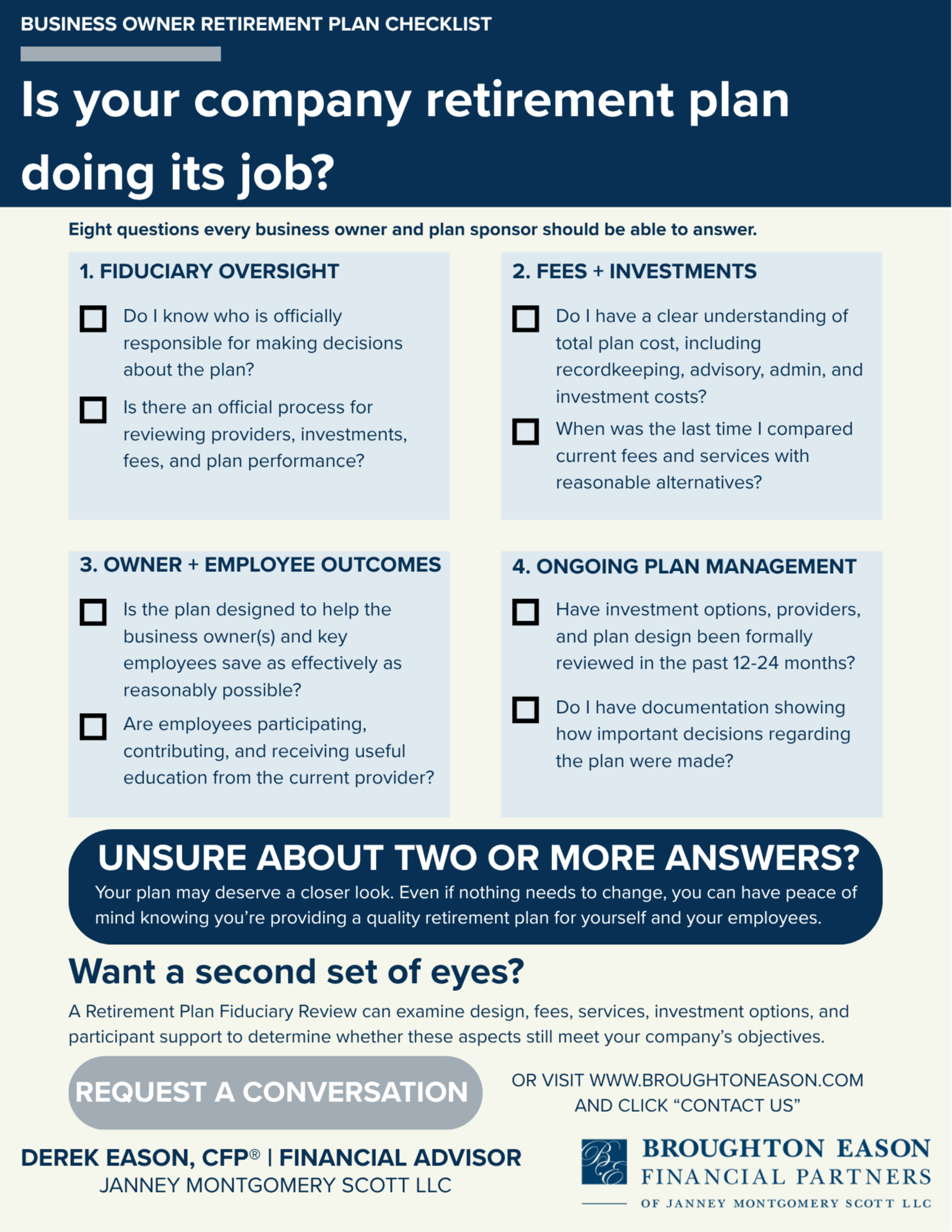
Business Owner Retirement Plan Checklist
Is your company retirement plan doing its job? As a business owner or entrepreneur, you may not always know where to begin to answer that question.To help you answer, we created a handy little checklist: 8 questions we believe business owners should be able to answer about their retirement plan.Still unsure? Click the "Contact Us" and fill out the requested information. We will be happy to schedule a call!

Retirement Plans for Small Businesses
If you own a small business and you haven't set up a retirement savings plan, what are you waiting for? A retirement plan can help you and your employees save on taxes while saving for the future.

Benefit Plans for Small Businesses
If you own a small business, you may be finding it increasingly necessary to implement a benefit program to attract and retain employees. For small businesses, benefit plans generally consist of some of the major insurance benefits, discussed here, as well as employer-sponsored retirement plans.

Starting or Buying a Business
So, you're thinking of going into business for yourself. You have several options available, and all involve some degree of risk. Do you want to create a start-up operation? Perhaps you are planning on buying an existing business. Or, you may be considering the purchase of a franchise operation. Each option involves some element of risk and reward. Whichever option you choose, however, owning your own business offers a chance at more freedom and greater financial rewards.

Choosing an Entity for Your Business
Now that you've decided to start a new business or buy an existing one, you need to consider the form of business entity that's appropriate for you. Basically, three separate categories of entities exist: partnerships, corporations, and limited liability companies. Each category has its own advantages, disadvantages, and special rules. It's also possible to operate your business as a sole proprietorship without organizing as a separate business entity.

Life Insurance for Business Owners
If you own your own business, chances are you've at least thought about the conditions under which you will leave the business and who is going to take over after you're gone. Business continuation is difficult enough under normal circumstances, but if it takes place following the unexpected death of a key person or owner, the complications can increase exponentially.

Life Insurance for the Self-Employed
If you're like most people, you bought life insurance to provide for your loved ones in the event of your death. But because you're self-employed, you may have an even greater need for life insurance: You'll want to protect your family after you die, as well as protect the financial needs of your business.

Understanding Individual 401(k) Plans
If you're self-employed or own a small business, you've probably considered establishing a retirement plan. If you've done your homework, you likely know about simplified employee pensions (SEPs) and savings incentive match plans for employees (SIMPLE) IRA plans. These plans typically appeal to small business owners because they're relatively straightforward and inexpensive to administer. What you may not know is that in many cases an individual 401(k) plan [which is also known by other names such as a solo 401(k) plan, an employer-only 401(k) plan, a single participant 401(k) plan, or a mini 401(k) plan] may offer a better combination of benefits. An individual 401(k) plan is worth considering if you're looking to set up your first retirement plan or want to switch to a different plan.

Transferring Your Family Business
As a business owner, you're going to have to decide when will be the right time to step out of the family business and how you'll do it. There are many estate planning tools you can use to transfer your business. Selecting the right one will depend on whether you plan to retire from the business or keep it until you die. Perhaps you have children or other family members who wish to continue the business after your death. Obviously, you'll want to transfer your business to your successors at its full value. However, with income, gift, and potential estate taxes, it takes careful planning to prevent some (or all) of the business assets from being sold to pay them, perhaps leaving little for your beneficiaries. Therefore, business succession planning must include ways not only to ensure the continuity of your business, but also to do so with the smallest possible tax consequences. Some of the more common strategies for minimizing taxes are explained briefly in the following sections. Remember, none are without drawbacks. You'll want to consult a tax professional as well as your estate planning attorney to explore all strategies.

Funding a Business
You've written your business plan, you're excited about your business idea, and now it's time to get started. One problem: You don't have the financing to fully realize your dream. What are your options? Aside from using your own funds and borrowing from friends and family, there are numerous routes that you can take, and each has its advantages and disadvantages. Here are some of the major options available for funding your small business, and some of the pitfalls to avoid.


