

KEY TAKEAWAYS
- Short-term market volatility is unavoidable, but long-term discipline matters most.
- Trying to time the market often hurts long-term results.
- Staying invested during downturns supports long-term goal achievement.
With changing market dynamics in recent years--including the advent of high-frequency and algorithmic trading, evolving central bank policy, and the continued rise of passive investing--market drawdowns can now occur faster than in years past and have become increasingly difficult to avoid.
Avoiding Common Pitfalls During Periods of Stress
During periods of market volatility, it is essential to consider your long-term investment goals, as decisions made during these periods can meaningfully affect the likelihood of achieving those objectives.
These goals—whether saving for college or retirement, planning for charitable giving, or addressing estate planning needs—are the foundation of most investment strategies and are the primary reason most participate in the markets in the first place.
During a market correction, it’s understandable to feel the urge to exit the market and sit on the sidelines until conditions improve. While this may feel reassuring in theory, history suggests it is difficult to execute successfully in practice.
Market returns over time can be dramatically influenced by just a handful of strong trading days. It is difficult, if not impossible, to predict when these outlier days may occur. As Exhibit A, attempting to exit and re-enter the market can significantly impact long-term performance and may reduce your ability to reach your goals.
Exhibit A: Stay invested: Missing top-performing days can hurt your return
The graph below shows how a hypothetical $100,000 investment in stocks would have been affected by missing the market’s top-performing days over the 20-year period from January 1, 2006 to December 31, 2025. For example, an individual who remained invested for the entire time period would have accumulated $806,201, while an investor who missed just five of the top-performing days during that period would have accumulated only $497,945.
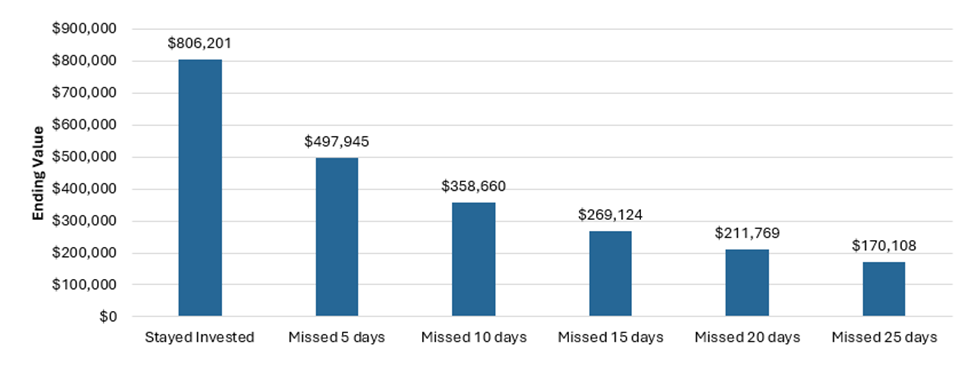
Sources: BlackRock; Bloomberg. Stocks are represented by the S&P 500 Index, an unmanaged index that is generally considered representative of the U.S. stock market. Past performance is no guarantee of future results. It is not possible to invest directly in an index.
*Janney makes no representation that an account will obtain gains or losses similar to those illustrated. There are distinct differences between hypothetical performance and performance achieved by actual trading platforms. Returns illustrated do not reflect any management fees, transaction costs, or expenses. Performance data quoted represents past performance and is no guarantee of future results. The S&P 500 is an unmanaged, capitalization-weighted index. Performance figures assume reinvestment of capital gains, dividends, but do not include fees or expenses. It is not possible to invest directly in the S&P 500.
Additionally, exiting the market following a sharp market decline has historically been shown to be an inopportune time to reduce exposure. Exhibit B shows the performance of the S&P 500 Index in the 12months following some of the market’s largest recent declines. Those sitting on the sideline for any sizable portion of that rebound would have likely seen their long-term performance suffer as a result.
Exhibit B: Annual Returns After Major Market Declines
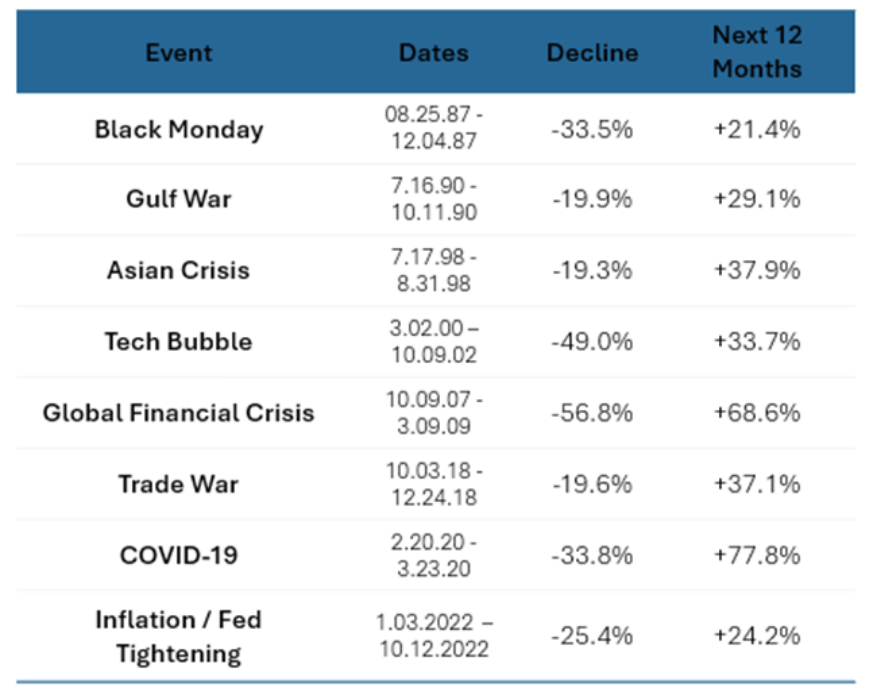
Source: Standard & Poor’s, FactSet, Bloomberg, and JP Morgan Asset Management. Data as of December 31, 2024.
Some investors may attempt to time the market by exiting ahead of a downturn. However, effective market timing is exceptionally difficult--even for highly skilled investors. What is often overlooked is that market timing requires two decisions: not only when to exit the market, but also when to re-enter to participate in the subsequent rebound.
Investors who attempt this strategy risk exiting too late to avoid much of the downturn, and then re-entering too late to capture a meaningful portion of the rebound. Over time, this approach can contribute to underperformance and may reduce the likelihood of achieving long-term investment objectives.
Keep Your Long-Term Goals in Focus
Remaining disciplined during a market downturn is challenging, as heightened volatility and portfolio losses can be difficult to endure. Nevertheless, maintaining focus on long-term investment goals is especially important during market stress when the timing of decisions can have an amplified impact on performance.
Working With Janney
Depending on your financial needs and personal preferences, you may opt to engage in a brokerage relationship, an advisory relationship or a combination of both. Each time you open an account, we will make recommendations on which type of relationship is in your best interest based on the information you provide when you complete or update your client profile.
If you engage in a brokerage relationship, you will buy and sell securities on a transaction basis and pay a commission for these services. Our recommendations for the purchase and sale of securities will be based on what is in your best interest and reflect reasonably available alternatives at that time.
If you engage in an advisory relationship, you will pay an asset-based fee, which encompasses, among other things, a defined investment strategy, ongoing monitoring, and performance reporting. Your Financial Advisor will serve in a fiduciary capacity for your advisory relationships.
For more information about Janney, please see Janney’s Relationship Summary (Form CRS) on www.janney.com/crs which details all material facts about the scope and terms of our relationship with you and any potential conflicts of interest.
By establishing a relationship with us, we can build a tailored financial plan and make recommendations about solutions that are aligned with your best interest and unique needs, goals, and preferences.
Contact us today to discuss how we can put a plan in place designed to help you reach your financial goals.
Janney Montgomery Scott LLC, its affiliates, and its employees are not in the business of providing tax, regulatory, accounting, or legal advice. These materials and any tax-related statements are not intended or written to be used, and cannot be used or relied upon, by any taxpayer for the purpose of avoiding tax penalties. Any such taxpayer should seek advice based on the taxpayer’s particular circumstances from an independent tax advisor.

