

Markets were volatile again in the third quarter but stocks still managed to advance, as strong corporate earnings growth and a resilient economy pushed the major indices to new all-time highs despite a rebound in oil prices and a surge in U.S. Treasury yields.
The third quarter started with moderate volatility as, during an otherwise strong Q2 earnings season, doubts began to emerge about valuations of AI infrastructure companies, which had powered markets higher throughout Q2. Very aggressive spending plans and related concerns about the sustainability of demand for AI components pressured market leaders such as Micron and Nvidia, and tech companies linked to AI declined sharply for most of July as investors worried the stocks had come too far, too fast. Those AI-related concerns were then compounded by a sudden resumption of fighting between the U.S. and Iran as, on July 13, the United States re-imposed a blockade on the Strait of Hormuz. That began a multi-day back and forth of attacks between the U.S. and Iran, and the collapse of the ceasefire boosted oil prices, which further weighed on stocks. The S&P 500 declined modestly for most of the month, although in late July tech giants Microsoft and Amazon posted strong earnings, and most importantly, made positive comments about revenues generated from AI investments. Those comments pushed back on the AI concerns from earlier in the month and triggered aggressive money flows back into tech and AI-related stocks. The S&P 500 rallied hard during the final days of July and recouped almost all of the monthly losses, finishing little changed.
The tech-led market rally from late July continued in early August, as the S&P 500 rose on a combination of AI-related tech outperformance and as the reciprocal attacks between the U.S. and Iran stopped. Fueled by AI enthusiasm and some encouraging growth and inflation data, the S&P 500 hit a new all-time high on August 12. Following those new highs, however, markets were forced to face the reality that stubbornly high inflation would likely cause the Federal Reserve to hike interest rates, and Fed Chair Warsh said as much at the Jackson Hole Economic Symposium. Expectations of rate hikes stopped the early August rally while geopolitics again impacted markets late in the month. The Houthis, an Iran-backed militia group, advanced to the Yemeni coast and threatened to harass ships exiting the Bab el-Mandeb Strait, further complicating global oil logistics. Oil prices rose as a result and that pulled Treasury yields higher, and those forces weighed on the S&P 500, although the index still finished the month with a 2.7% gain.
The late-August volatility continued in early September, as the Houthis made a lightning advance up the Yemeni coast (giving them more ability to harass tankers) while Iranian-aligned groups sabotaged the East-West pipeline in Saudi Arabia, further reducing oil flows from the Middle East. The Fed, meanwhile, raised interest rates 25 basis points in September and signaled more rate hikes were likely. That news pressured stocks and boosted bond yields, as the 10-year Treasury yield surged to a 19-year high in late September on a combination of strong economic data, higher oil prices and Fed rate hike expectations. Higher yields pressured stocks late in the month and the S&P 500 finished with a slight loss.
In sum, the third quarter contained its share of disconcerting geopolitical headlines and market volatility, but strong earnings growth and resilient economic growth offset the headwinds of higher oil prices, Fed rate hikes and rising Treasury yields.
Third Quarter Performance Review
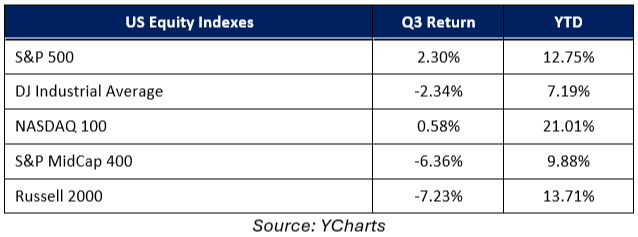
The three major influences on the markets in the third quarter were rising oil prices, surging Treasury yields and AI enthusiasm, and those factors heavily influenced market internals and performance.
By market capitalization, small caps badly lagged large caps in the third quarter and declined outright, as surging yields weighed on small caps while large caps benefitted from tech and energy rallies tied to AI and higher oil prices.
From an investment style standpoint, growth again handily outperformed value, thanks primarily to strength in the tech sector. While volatile, tech-heavy growth styles benefitted from a continued AI rally while value sectors were pressured by concerns about rising yields and higher oil prices.
On a sector level, performance was mixed in Q3 as only four of the 11 S&P 500 sectors finished the quarter with positive returns. Surging oil prices and AI enthusiasm were the main drivers of sector performance in Q3 as energy was, by far, the best-performing sector in the S&P 500. Oil and energy-related stocks surged courtesy of dramatically higher oil prices throughout the quarter. Other sector outperformers included tech, which benefitted from ongoing AI enthusiasm (especially late in the quarter) and healthcare, as a series of high-profile successful drug trials boosted pharmaceutical stocks.
Turning to sector laggards, the influence of higher yields was evident, as utilities were, by far, the worst-performing sector in the S&P 500 and logged a material decline. Rising bond yields make the high dividends in utility stocks less attractive to investors and money rotated from utilities into different parts of the market throughout the quarter. Industrials also logged a materially negative return for the quarter thanks to concerns that higher rates could negatively impact economic growth while surging diesel costs pressured transportation companies.
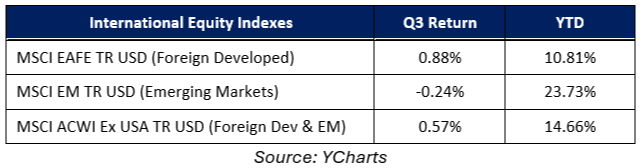
International market performance was also influenced by tech/AI as both foreign developed and emerging markets lagged the S&P 500. Foreign developed markets did log a marginally positive return for the quarter, but foreign indices have a smaller allocation to AI-related tech shares and that weighed on performance. Emerging markets, meanwhile, declined slightly as a stronger dollar pressured those investments.
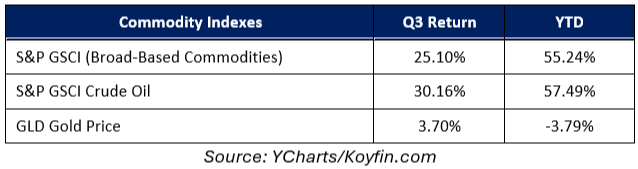
Commodities were, by far, the best-performing major asset class in the third quarter as an explosion higher in oil prices powered widely held commodity indices to strong quarterly gains. Brent crude traded back above $100/bbl during the third quarter and diesel prices surged to record highs, as the collapse of the U.S./Iran ceasefire, expansion of the conflict by the Houthis and increased attacks on Russian infrastructure by Ukraine disrupted the flow of oil and refined products globally. Gold, meanwhile, spent most of the quarter in modestly positive territory on higher inflation concerns and elevated geopolitical risks.
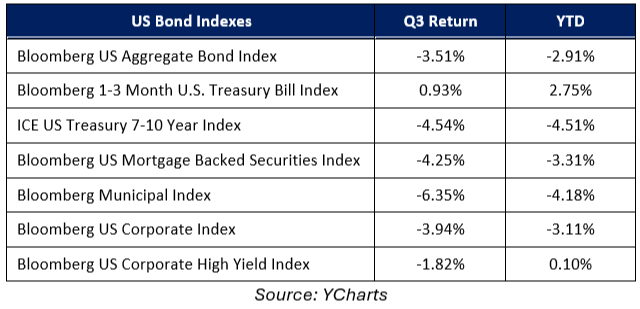
Switching to fixed income markets, the leading benchmark for bonds (Bloomberg U.S. Aggregate Bond Index) declined sharply in the third quarter as rising inflation concerns pressured multiple types and classes of fixed income.
Looking deeper into the bond markets, shorter-duration bills logged a modestly positive return for Q3 and handily outperformed longer-duration bonds, as inflation concerns weighed on longer-dated bonds.
Turning to the corporate bond market, both investment grade and lower quality, but higher-yielding bonds posted negative quarterly returns. High-yield bonds relatively outperformed, however, as resilient economic growth and higher inflation metrics prompted investors to reach for higher yield despite greater credit risks.
Fourth Quarter Market Outlook
As we begin the final quarter of the year, there are headwinds on markets via the ongoing U.S./Iran conflict, surging global bond yields, and the threat of more Fed rate hikes. However, it’s important to realize there are less-exciting, but still-powerful, forces supporting this year-to-date rally in the form of 1) Impressive economic growth, and 2) Historically strong corporate earnings growth, and those two substantial positives can overcome macroeconomic headwinds, as they did in the third quarter.
Starting with economic growth, it remained strong and accelerated during the third quarter. Readings from the labor market were very healthy, consumer spending remained strong despite higher prices and activity in the manufacturing and service sectors of the economy accelerated. The Atlanta GDP Now forecast showed GDP growth of 5.0% in late September and the reality is that strong economic performance provides a formidable foundation for the YTD rally.
On earnings, 2027 S&P 500 earnings estimates were revised higher, again, following the Q2 earnings season and annual earnings growth continued to trend far above historical averages. Beyond reflecting increased corporate profits (which are good for stock prices), surging earnings expectations have helped to keep market valuations reasonable, as the S&P 500 traded below the five-year average for valuation through the third quarter despite the strong YTD rally.
Bottom line, while many of the headlines have focused on the threats to the rally, there are powerful positive forces supporting stocks and risks assets more broadly. That said, there are legitimate risks to the market that must be monitored closely in the fourth quarter.
Starting with geopolitics, the stalemates in the U.S./Iran and Russia/Ukraine wars continue, and they are keeping oil, gas and diesel prices elevated. The longer that continues, the greater the headwind it will become on economic growth. Positively, any real diplomatic progress in either theatre that allows oil or diesel to flow more freely will result in lower energy prices and that should be a significant, positive catalyst for markets.
Turning to Treasury yields, the 10-year yield did hit a 19-year high during the third quarter and that is a headwind on economic growth. However, much of the rise in the 10-year yield can likely be attributed to rising oil prices, and if we see a decline in oil, then yields will likely follow and reduce the headwind on the economy.
Regarding the Federal Reserve, investors have priced in additional rate hikes in 2026 and 2027, but limited rate hikes that help contain inflation will be a longer-term positive. Additionally, if inflation metrics ease during the fourth quarter, then rate hike expectations will be reduced and that will put downward pressure on Treasury yields.
Finally, concerns remain that the AI data center boom will turn “bust” and hurt economic growth. Those fears are understandable, especially for older investors who remember the “dot com” era. However, important differences exist between the two periods and there were signs in the third quarter that AI investments were already beginning to generate revenue. If there is more evidence of that in the fourth quarter, then investor concerns about the sustainability of the AI buildout will ease and tech will likely lead markets higher once again.
In sum, we begin the final quarter of 2026 with a market facing challenges in the form of geopolitical risks, higher bond yields and concerns about the sustainability of the AI data center boom. But the positives of a resilient economy and historically strong earnings growth are powerful, and despite negative headlines, the reality is the market remains on solid footing.
At Towson Partners Wealth Management, we understand the risks facing both the markets and the economy, and we are committed to helping you effectively navigate this challenging investment environment. Successful investing is a marathon, not a sprint, and even intense volatility is unlikely to alter a diversified approach set up to meet your long-term investment goals.
Therefore, it’s critical for you to remain patient, and stick to the plan, as we’ve worked with you to establish a unique, personal allocation target based on your financial position, risk tolerance, and investment timeline.
Rest assured that our entire team will remain dedicated to helping you successfully navigate this market environment.
Please do not hesitate to contact us with any questions, or comments, or to schedule a portfolio review.
Sincerely,
Towson Partners

