

Why Wealthy Families Should Plan Before the Problem Gets Bigger
One of the most expensive mistakes a wealthy family can make is waiting too long to plan.
Estate taxes are based on what you own when you die, not simply what you are worth today. A successful business, real estate, retirement accounts and an investment portfolio can compound for decades and turn a manageable estate into a significant tax problem.
In 2026, the federal estate and gift tax exemption is $15 million per person. For a married couple, proper planning and portability may potentially preserve roughly $30 million of federal exemption. The federal estate tax rate reaches 40%.
State taxes can become an issue much sooner.
Towson Partners Wealth Management works with families throughout the country, but we are based in Maryland, where many of our clients live. Maryland's estate tax exemption is only $5 million per person, although unused exemption may potentially be preserved for a surviving spouse through Maryland portability. Maryland estate tax can reach 16%.
That makes estate planning a particularly familiar issue for us, but it is by no means only a Maryland issue. Twelve states plus Washington, D.C. impose their own estate taxes, often at thresholds well below the federal exemption.
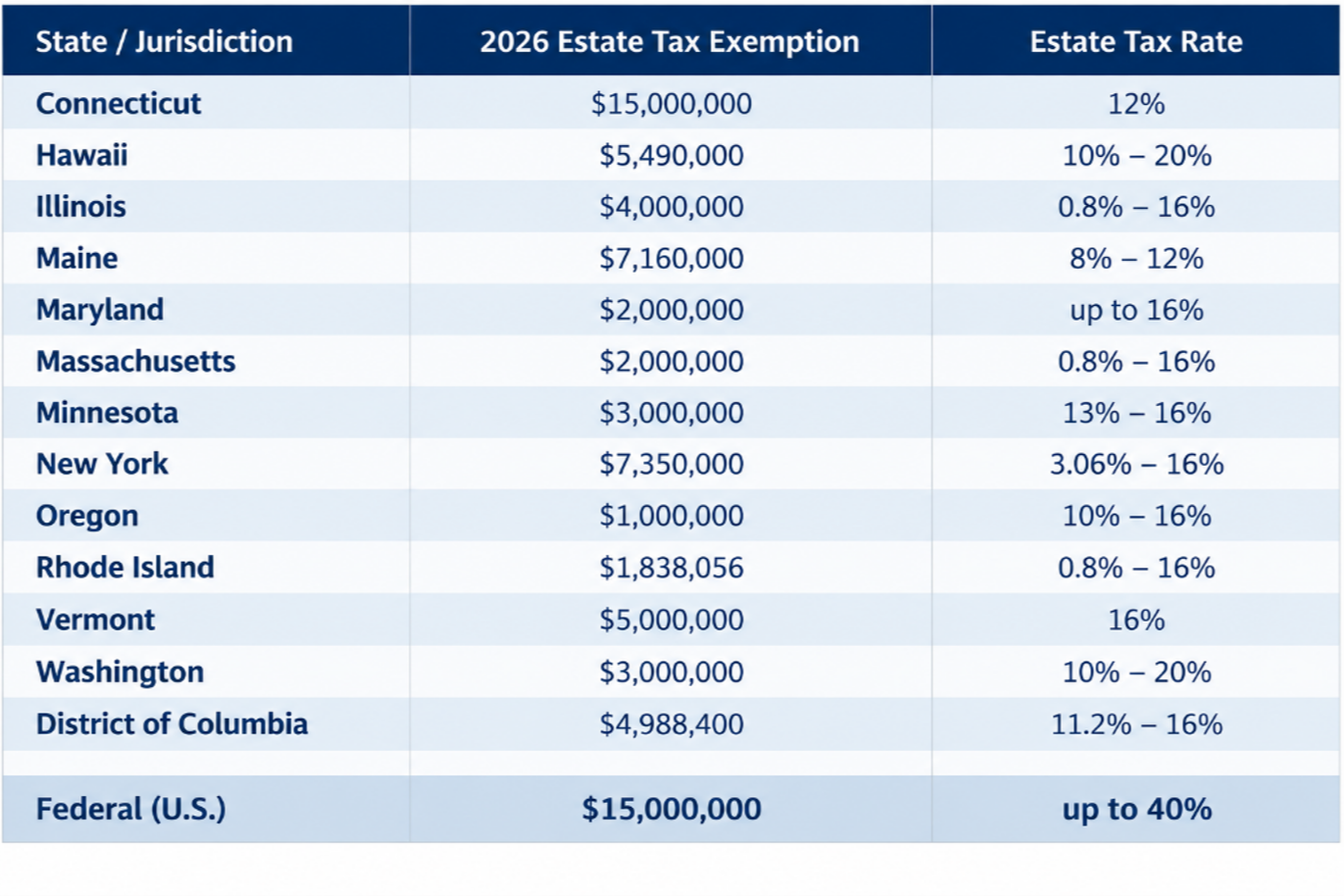
The Problem Is Often the Growth
A $10 million estate growing at 6% annually becomes roughly $18 million in 10 years and $32 million in 20 years.
A $15 million estate becomes approximately $27 million and then $48 million.
These are simple illustrations, not forecasts, but they make the point:
You may not have an estate tax problem today. You may be growing into one.
The federal lifetime exemption can generally be used through taxable gifts during your lifetime or against your estate at death.
Why might someone use part of that exemption earlier?
Because the asset can then have years to appreciate outside the taxable estate.
If $5 million transferred today hypothetically grows at 7% for 20 years, it becomes approximately $19 million.
The original $5 million mattered.
But so did the roughly $14 million of future appreciation.
Move the growth before the growth happens.
Start With the Financial Plan, Not the Trust
We believe wealthy families should often do the financial planning before asking an attorney to draft complicated estate documents.
Estate planning attorneys are essential. They understand the law, draft the trusts and make sure a strategy is structured properly.
But first, the family needs to understand what it is trying to accomplish.
At Towson Partners Wealth Management, our financial planning process can help clients visualize questions such as:
- What could our estate eventually be worth?
- What happens if we do nothing?
- How much can we comfortably transfer today?
- Do we still have more than enough if markets decline or we live to 100?
- What might different strategies mean for our children, grandchildren and charities?
We can model a $2 million gift versus $5 million versus doing nothing.
The client can actually see the effect on future net worth, spending capacity, projected estate size and family wealth.
That makes the eventual attorney meeting far more productive.
Instead of walking in and asking:
“Do I need a trust?”
the client can walk in saying:
“Our financial plan shows we are unlikely to ever need these assets and can comfortably transfer $4 million. How should we structure that for our family?”
Figure out the strategy first. Then have the attorney build the legal structure around it.
The Estate Planning Toolbox
Once the goal is clear, there are many ways to address it.
Annual gifting. In 2026, the federal annual gift tax exclusion is $19,000 per recipient, and each spouse has a separate exclusion. Qualifying annual exclusion gifts generally do not use the donor's lifetime exemption.
529 plans. A donor may elect to spread up to five annual exclusions over five years for a 529 contribution. At the current $19,000 exclusion, that is as much as $95,000 per donor, per beneficiary under the election.
Irrevocable trusts and SLATs. Families with significant assets they are unlikely to need may want to discuss moving appreciating assets into properly structured trusts with their estate attorney.
Special needs planning. A family with a child or grandchild with a disability may need a properly designed special needs trust instead of an outright inheritance. SSA recognizes qualifying special needs trusts as exceptions to its normal SSI trust resource rules. ABLE accounts can also provide tax favored savings for eligible beneficiaries and qualified disability expenses. Beginning in 2026, the disability onset age for ABLE eligibility increased from 26 to 46.
Trusts for beneficiaries who need help managing money. Some heirs should not receive several million dollars outright. A properly drafted trust with an appropriate trustee can provide structure and oversight.
Roth conversion planning. Traditional IRA distributions received by heirs are generally taxable, and many nonspouse beneficiaries are subject to the 10 year inherited IRA rule. For the right family, it may make sense to model paying some income tax during the parents' lifetime rather than leaving the entire future tax burden to the next generation.
Charitable planning. Families who already intend to support charities should also think about which assets go to family and which go to charity. The tax characteristics can be very different.
There is no single answer.
The point of the financial plan is to show the family why one strategy may make sense and another may not before they commit to it.
Gifting Can Tell You Something About Your Heirs Too
Lifetime gifting has another benefit that does not show up on an estate tax return.
You get to see your family enjoy the money while you are still here.
Grandparents can watch a grandchild go to college.
Parents can help a child buy a home, build an investment account or create financial security.
That can be far more rewarding than having children receive everything after Mom and Dad are gone.
But there is another useful side effect.
Lifetime gifts give parents and grandparents a chance to see how the next generation actually handles money.
Does your daughter invest the annual gift?
Does your son immediately spend it?
Does a grandchild save part of it?
Does a son in law or daughter in law make thoughtful financial decisions?
In a sense, smaller lifetime gifts can become a real world test run for a much larger inheritance.
If an adult child receives $38,000 every year and consistently saves and invests it, Mom and Dad may become more comfortable leaving that child assets outright.
If the money disappears every year, that is useful information too.
Perhaps the eventual inheritance should remain in trust with an independent or trusted trustee.
The family learns this while there is still time to change the estate plan.
That can be every bit as valuable as the tax savings.
Case Study: Doing Nothing vs. Planning
Consider a hypothetical Maryland couple with:
$12 million of net worth today
3 adult children
3 spouses of those children
6 grandchildren
Assume their financial plan shows they have more than enough to support their lifestyle, even under conservative assumptions.
They therefore have 12 family members they ultimately intend to benefit.
Option 1: Do Nothing
Suppose the entire $12 million estate remains in Mom and Dad's names and grows at a hypothetical 6% annually for 10 years.
The estate grows to approximately:
$21.5 million
Assume both Maryland $5 million exemptions have ultimately been preserved through proper portability planning, giving the surviving spouse a hypothetical combined $10 million Maryland exclusion under current law.
That leaves roughly $11.5 million above the combined exclusion.
For a simplified illustration assuming all assets are subject to Maryland estate tax, no other deductions or credits, and current law remains unchanged, Maryland's 16% limitation could produce an estate tax of roughly:
$1.84 million
The actual Maryland estate tax calculation is more complicated, and the MET 1 calculation uses the lesser of several amounts, but the state's return specifically applies a 16% limitation to the amount above the applicable Maryland exclusion.
The family waited.
The assets compounded.
And a substantial portion of the wealth went to taxes instead of the family.
Option 2: Start Gifting Intentionally
Instead, the financial plan shows that Mom and Dad can comfortably begin transferring wealth now.
In 2026, each spouse can generally give $19,000 to each recipient under the annual exclusion.
With 12 recipients:
$19,000 × 12 recipients × 2 spouses = $456,000 per year
Assuming the gifts qualify for the annual exclusion and the applicable ownership and reporting rules are satisfied, the couple could potentially transfer:
$4.56 million over 10 years
without using federal lifetime exemption for those qualifying annual exclusion gifts.
If each year's gifts are invested and hypothetically earn the same 6%, those gifts could be worth approximately:
$6.0 million after 10 years
Meanwhile, Mom and Dad's remaining estate would be approximately:
$15.5 million
rather than $21.5 million.
Using the same simplified Maryland assumptions, the amount above a hypothetical $10 million combined Maryland exclusion falls to roughly $5.5 million, producing an illustrative Maryland estate tax of approximately:
$877,000
The Difference
Do Nothing
Annual Gifting Plan
Estate after 10 years
~$21.5M
~$15.5M
Wealth already moved to family
$0
~$6.0M*
Illustrative Maryland estate tax
~$1.84M
~$877K
Illustrative estate tax reduction
—
~$960K
*Includes hypothetical 6% investment growth on the annual gifts.
That is almost $1 million potentially staying with the family instead of going to estate tax, before considering any additional planning strategies.
And there is another benefit.
Mom and Dad have spent ten years watching their children and grandchildren use the gifts.
Maybe one child built a diversified investment portfolio.
Another used the money responsibly to pay down a mortgage.
A third spent every dollar.
That experience gives the parents valuable information about the next decision.
Who can responsibly inherit assets outright?
Who may benefit from a trust?
Who might need a professional or family trustee?
Which grandchildren are already developing good financial habits?
And throughout the process, Towson Partners can work with the children and grandchildren to help them invest the gifts thoughtfully, develop their own financial plans and become better stewards of family wealth.
The family did not simply give money away.
They changed where the money was growing, watched how the next generation handled it, and planned the eventual inheritance with much better information.
That is sophisticated estate planning in practical terms.
The Worst Strategy Is Kicking the Can Down the Road
The most frustrating result is a wealthy family that knows it should plan but keeps saying:
“We'll deal with it later.”
Later, the portfolio is larger.
The business is worth more.
The real estate has appreciated.
And eventually someone dies.
At that point, many lifetime planning opportunities are gone.
At Towson Partners Wealth Management, our role is to help clients see the problem while they still have time to do something about it.
We build the financial plan.
We model the alternatives.
We help determine what the client can comfortably transfer.
We help the next generation invest and plan responsibly.
And we work alongside the family's estate planning attorneys and tax professionals to turn the financial strategy into the appropriate legal structure.
The objective is not the most complicated estate plan.
It is to keep what you need, intelligently plan for what you do not need, and help more of what you spent a lifetime building reach the people and organizations you actually care about.
You may not have an estate tax problem today.
The real question is what happens if you wait until you do.
Important Disclosure
This material is provided for informational and educational purposes only and should not be construed as individualized investment, tax or legal advice or as a recommendation to implement any particular strategy. Tax and estate planning laws are complex, subject to change and dependent upon individual circumstances.
Hypothetical examples are provided solely for illustrative purposes and do not represent actual client results. Hypothetical investment returns are not guaranteed, and actual results will vary. Estate tax calculations shown are simplified illustrations and may differ materially from an actual estate tax return.
Towson Partners Wealth Management and Janney Montgomery Scott LLC do not provide legal or tax advice. Clients should consult qualified estate planning attorneys, accountants and other tax professionals before implementing estate, gift, trust, charitable, special needs or Roth conversion strategies.
Compliance Sources
IRS, Frequently Asked Questions on Gift Taxes
2026 annual exclusion, per recipient and per spouse:
IRS, Frequently Asked Questions on Estate Taxes
2026 federal estate tax filing threshold of $15 million and federal portability:
IRS, Instructions for Form 706
Federal estate tax rate schedule:
https://www.irs.gov/instructions/i706
IRS, Instructions for Form 709
Annual exclusion and five year 529 election:
https://www.irs.gov/instructions/i709
Maryland Comptroller, Estate and Inheritance Tax FAQs
$5 million Maryland exclusion, portability and estate tax calculation:
Maryland Estate Tax Return, Form MET 1
Maryland estate tax computation and 16% limitation:
https://www.marylandcomptroller.gov/content/dam/mdcomp/tax/forms/2025/met-1.pdf
Maryland General Assembly, Tax General §7-309
Maryland estate tax exclusion and portability statute:
https://mgaleg.maryland.gov/mgawebsite/laws/StatuteText?article=gtg&enactments=false§ion=7-309
Tax Foundation, State Estate and Inheritance Taxes
State estate tax thresholds and rates; Maryland's estate and inheritance taxes:
https://taxfoundation.org/data/all/state/estate-inheritance-taxes/
Social Security Administration, Spotlight on Trusts
Special needs trust treatment under SSI rules:
https://www.ssa.gov/ssi/spotlights/spot-trusts.htm
IRS, ABLE Accounts
Tax favored ABLE account rules:
IRS, Instructions for Forms 1099-QA and 5498-QA
2026 expansion of ABLE eligibility based on disability onset before age 46:
https://www.irs.gov/instructions/i1099qa
IRS, Retirement Topics: Beneficiary
Inherited IRA beneficiary and 10 year distribution rules:
https://www.irs.gov/retirement-plans/plan-participant-employee/retirement-topics-beneficiary
IRS, Publication 590-B
Taxation of inherited traditional IRA distributions:
https://www.irs.gov/publications/p590b
Working With Janney
Depending on your financial needs and personal preferences, you may opt to engage in a brokerage relationship, an advisory relationship, or a combination of both. Each time you open an account, we will make recommendations on which type of relationship is in your best interest based on the information you provide when you complete or update your client profile.
If you engage in a brokerage relationship, you will buy and sell securities on a transaction basis and pay a commission for these services. Our recommendations for the purchase and sale of securities will be based on what is in your best interest and reflect reasonably available alternatives at that time.
If you engage in an advisory relationship, you will pay an asset-based fee, which encompasses, among other things, a defined investment strategy, ongoing monitoring, and performance reporting. Your Financial Advisor will serve in a fiduciary capacity for your advisory relationships.
For more information about Janney, please see Janney’s Relationship Summary (Form CRS) on www.janney.com/crs, which details all material facts about the scope and terms of our relationship with you and any potential conflicts of interest.
By establishing a relationship with us, we can build a tailored financial plan and make recommendations about solutions that are aligned with your best interest and unique needs, goals, and preferences.
Contact us today to discuss how we can put a plan in place designed to help you reach your financial goals.
For more information about Janney, please see Janney’s Relationship Summary (Form CRS) on www.janney.com/crs which details all material facts about the scope and terms of our relationship with you and any potential conflicts of interest.
To learn about the professional background, business practices, and conduct of FINRA member firms or their financial professionals, visit FINRA’s BrokerCheck website: http://brokercheck.finra.org/

